If you read nothing else
- About thirty metres at the lip and sixty at the base.
- Dynjandi plus six named waterfalls below it on the Dynjandisa.
- It means the thundering one, and you hear it before you see it.
- A natural monument, decades before Iceland became busy.
The shape, which is the whole thing
Nearly every famous waterfall gets narrower on the way down. Water in free fall pulls together, so a plunge that starts wide arrives as a column. Dynjandi runs the opposite way, and that is the reason it is worth crossing a mountain range to look at.
The river arrives at a lip roughly thirty metres across. Below the lip is not empty air but a face of basalt laid down in horizontal sheets, one lava flow on top of another, each one weathered back a little further than the one above it. The result is a staircase, and the water has to run down it rather than fall past it.
Every step spreads the flow a little wider. At the bottom the sheet of water is around sixty metres across, twice what it was at the top, which is why every photograph of it looks like fabric rather than a river. Icelanders have called it a bridal veil for a long time and it is difficult to improve on.
A hundred metres, and how to feel it
The drop is about a hundred metres. That number means very little until there are people at the bottom of it, at which point it stops being a number.
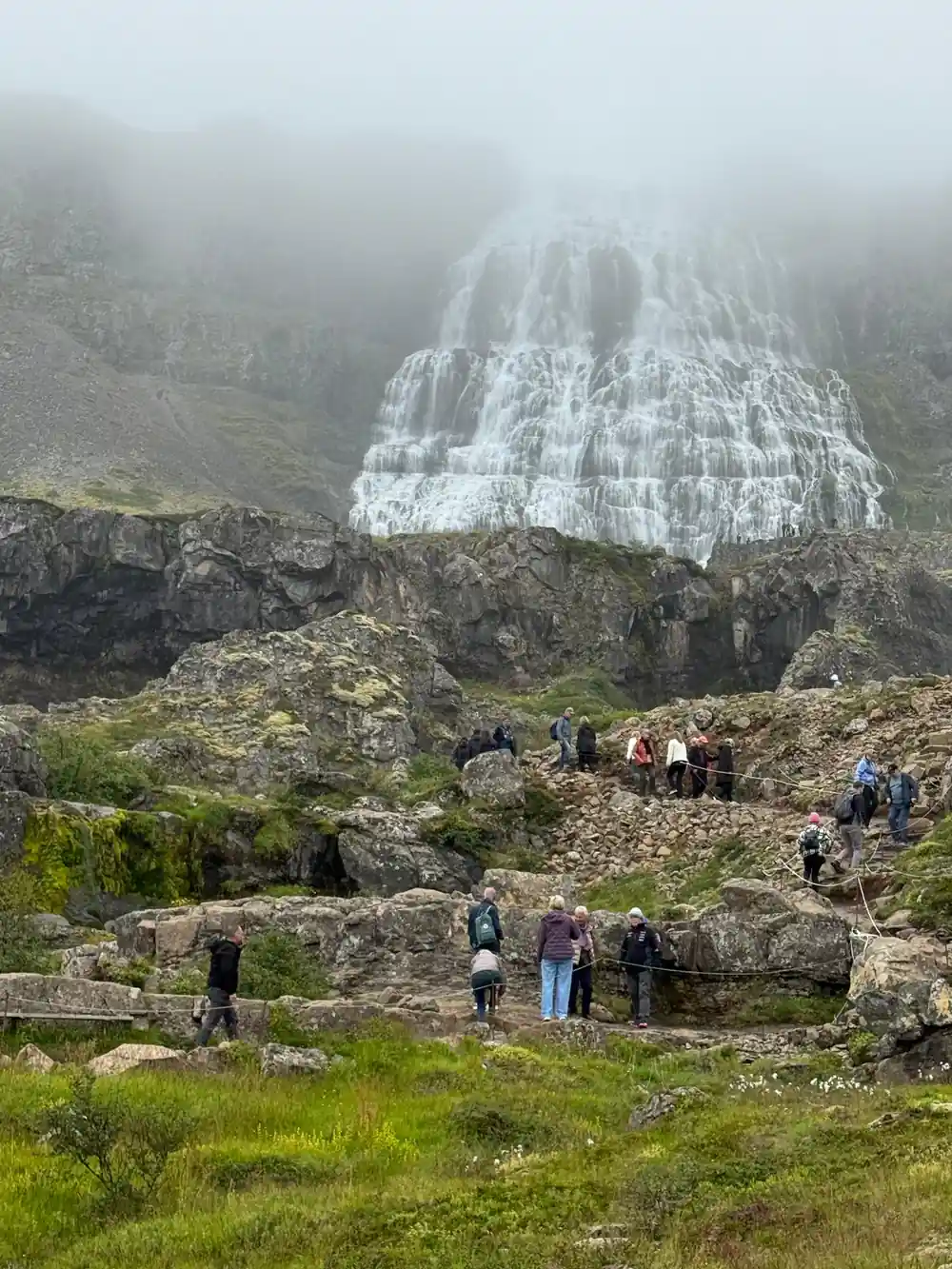
This is the single most useful piece of advice for a visitor: wait until somebody walks to the base before you take your photograph. Without a figure in the frame the fall could be twenty metres or two hundred, because there is nothing else in the landscape to give it scale. With one, the size becomes obvious and slightly alarming.
The other clue is sound. Standing at the car park, several hundred metres away and well below it, the fall is already loud enough to talk over. Water making that much noise from that far away is doing something substantial.
In practice the sound is the first thing anyone reacts to. People get off a coach into what sounds like heavy traffic and then work out that it is water.
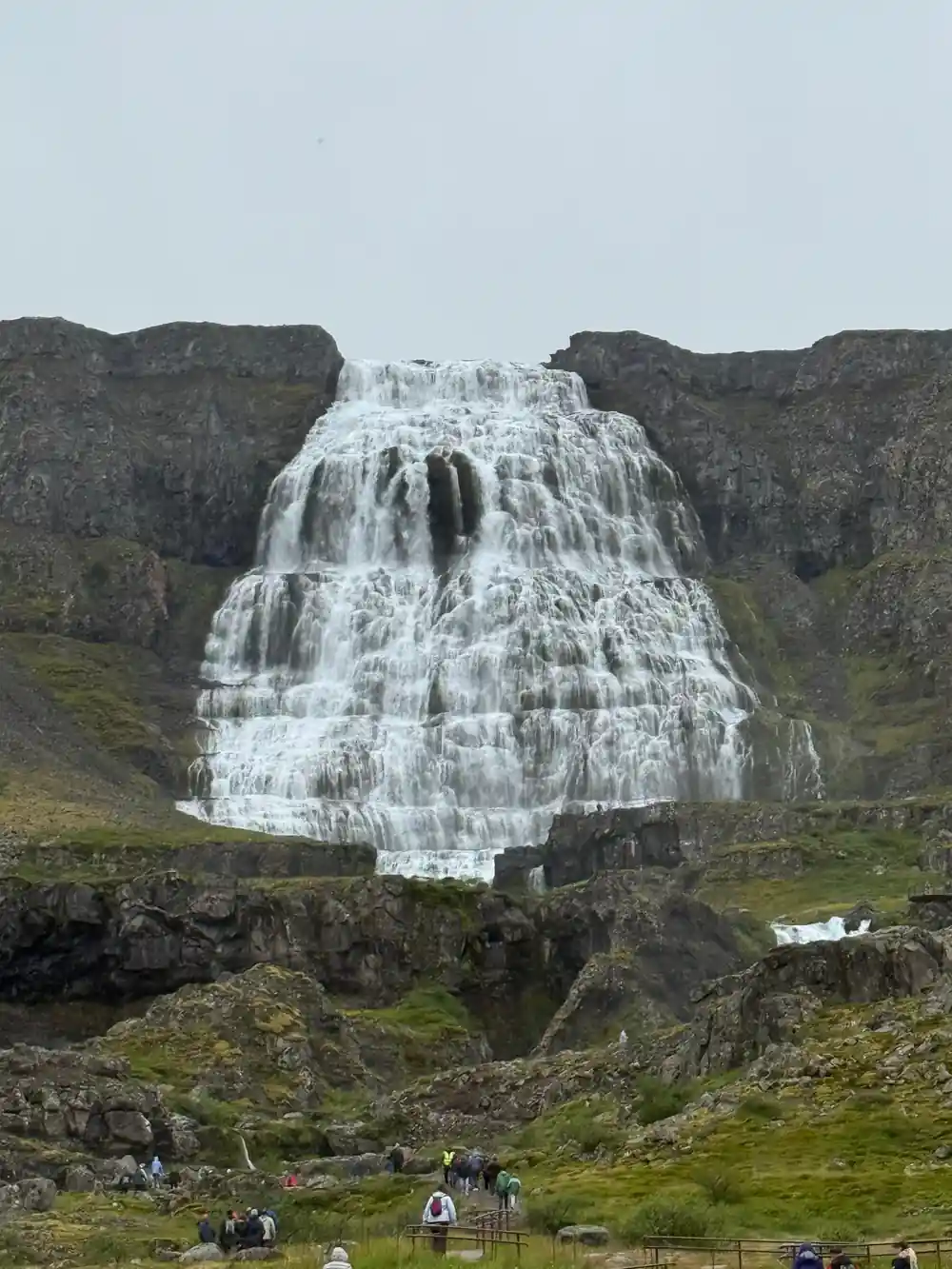
The fan of Dynjandi, wider at the base than at the lip
The name, and the other name
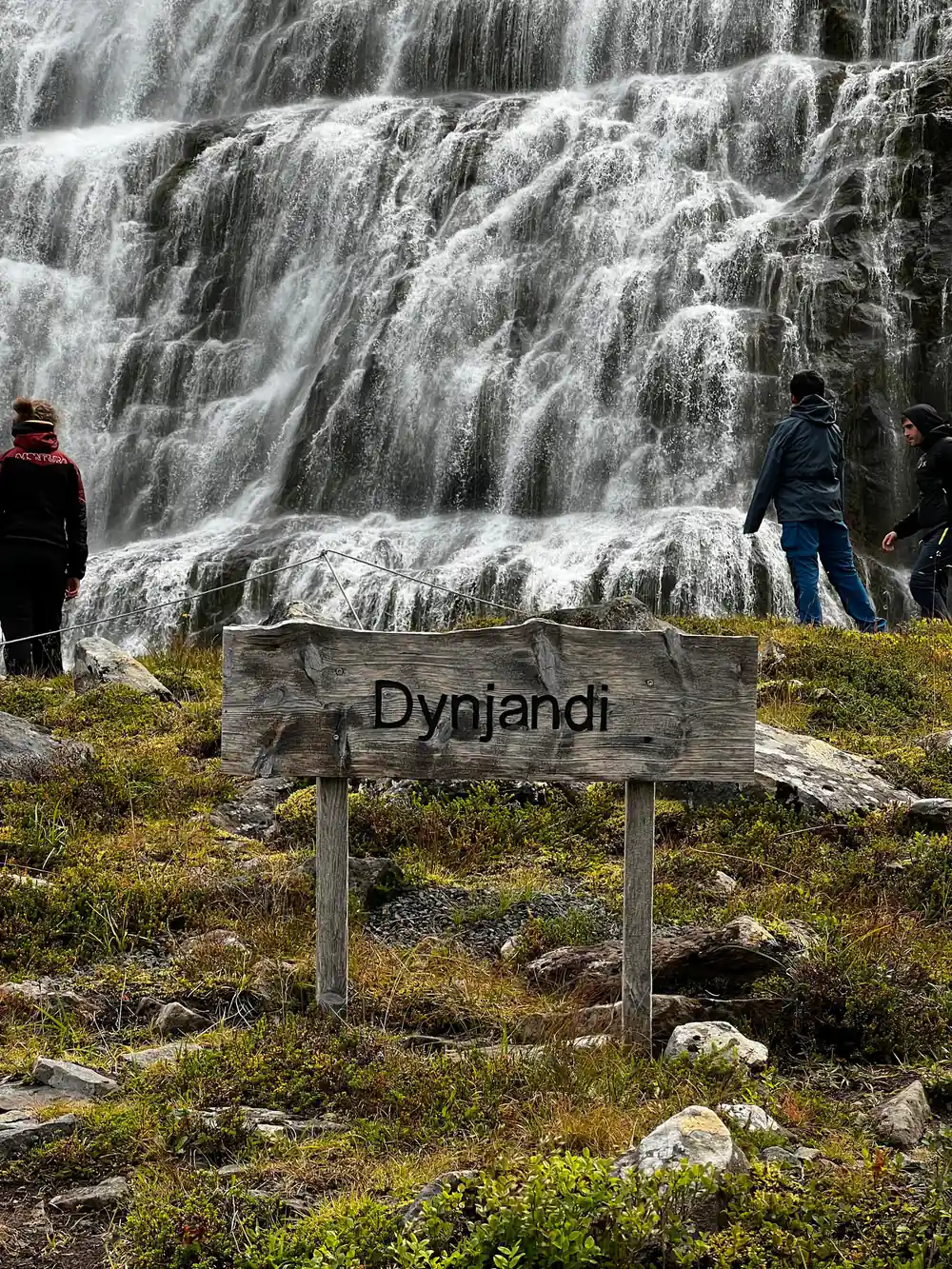
Dynjandi comes from the Icelandic verb for a deep resounding noise. The name is a description rather than a label: the thundering one, the one that booms. Whoever named it did so from a distance, in an age when nobody had a road.
It also has a second name, Fjallfoss, which simply means the mountain falls. Both are still used, and older maps and books will sometimes give one and sometimes the other. Dynjandi is what everyone says now.
The bay it falls into is Dynjandisvogur, at the head of Arnarfjörður, and the river is the Dynjandisá. In Icelandic the waterfall names the water, the bay and the valley, which is a tidy piece of evidence for how much it dominates this particular corner of the map.
The six below it
Everyone photographs the big one and then discovers, on the way up, that the river has been busy the whole way down the slope.
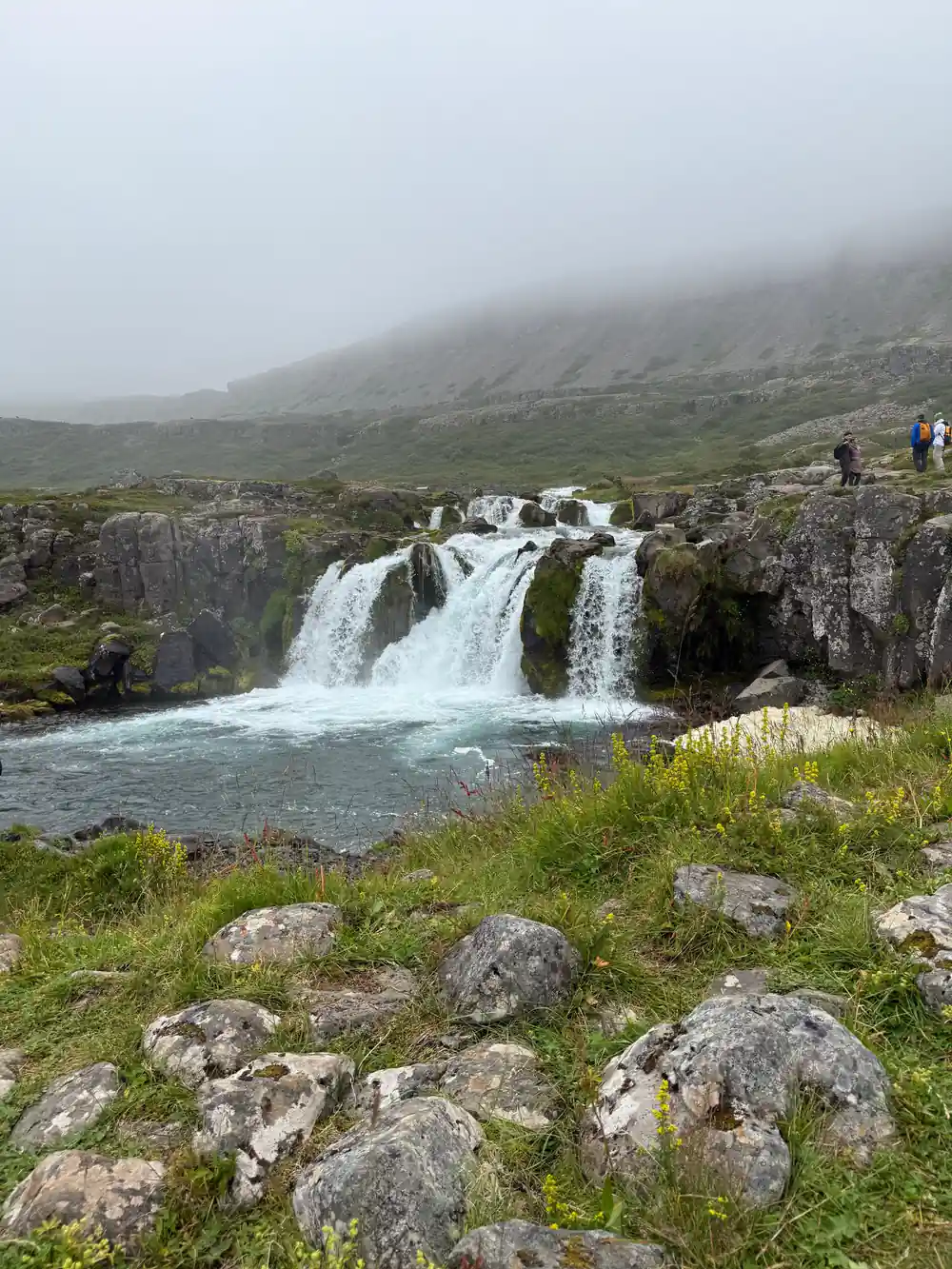
Six further waterfalls sit between the car park and the base of Dynjandi, each named individually, and the path passes all of them. They are not consolation prizes. One drops as a broad curtain into a pool the colour of glacier melt; another squeezes into a gorge and comes out white; another spreads over a green rock terrace in a dozen separate threads.
Any one of them, sitting on its own beside a road in another country, would have a car park and a café. Here they are the things you walk past on your way to the main event, and most visitors spend more time on them than they intended to.
They are, from the top down, Haestahjallafoss, Strompgljufrafoss, Gongumannafoss, Hrisvadsfoss, Hundafoss and Baejarfoss, the last of which is also called Sjoarfoss because it is the one nearest the sea. Nobody expects a visitor to keep those straight, but it is worth knowing that each one was named individually rather than lumped together as scenery.
Twice wide
About thirty metres across where the water goes over, about sixty where it lands. The basalt staircase underneath it does the work.
Why it is protected
Dynjandi and the falls below it were declared a natural monument in 1980, which put the site and the ground around it under formal protection.
That date is worth noticing. It was made long before Iceland's visitor numbers began their climb, at a time when this valley saw a handful of people a week rather than a coach at a time, and it was a decision about the place rather than a reaction to pressure on it.
The practical consequence is the one you can see: a marked path, a rope where the ground is unstable, a car park set well back, and no building anywhere near the fall. Everything is arranged so that the waterfall is the only thing in the frame, and that is not an accident.
It is also why the site has aged well. A waterfall this size in a country with this many visitors could easily have acquired a viewing platform, a gift shop and a coach park at its foot. This one has a path and a rope, and it looks very much as it did when the protection order was signed.
A hundred metres of water, spreading all the way down
from US$144Reserve now & pay later